

At the very least since the politically motivated decision not to make Anthropic’s latest model, Fable, available in Europe for the time being, Europe’s technological dependence on U.S. providers has shifted from a much-discussed theoretical threat to a concrete reality. The ensuing debate has been followed by numerous political initiatives and commitments to greater technological sovereignty. However, small and medium-sized enterprises don’t have to wait for this to happen: They can already align their AI investments today in a way that ensures they remain future-proof even amid changing market and regulatory conditions.
In this article, we examine which criteria—when selecting an AI platform—determine whether data sovereignty will be preserved in the long term.
1. Technology-agnostic AI platform
A technology-agnostic AI platform is characterized by several features. Support for and flexible use of various LLMs form the foundation for a future-proof AI strategy. This is because not only is the performance of these models evolving rapidly—their optimal areas of application are also constantly changing. A model that is the best choice for a specific task today may be replaced tomorrow by a more powerful or cost-effective alternative.

Open APIs and standardized interfaces are equally crucial. They enable seamless integration into existing enterprise systems and lay the foundation for an interoperable AI landscape. New technologies and standards—such as the Model Context Protocol (MCP) for the standardized connection of AI agents to enterprise systems—can thus be easily integrated. This keeps the platform open to future innovations, reduces proprietary dependencies, and protects existing investments.
2. Data Sovereignty Through Flexible Operating Models
Companies vary significantly in terms of their data protection, compliance, and IT infrastructure requirements. While a traditional cloud environment may be sufficient for some use cases, the location and operator of the cloud infrastructure also play a decisive role in choosing the operating model. Cloud offerings from major international providers such as Microsoft Azure, AWS, or Google Cloud may be suitable for many scenarios, while regulated industries in particular are increasingly turning to European cloud providers such as Open Telekom Cloud, Hetzner, or OVHcloud to meet stricter requirements for data sovereignty and compliance. For particularly sensitive use cases—such as in the financial or healthcare sectors—a private cloud or on-premises solution may be required, in which confidential information is processed within the organization’s own control boundaries. A sovereign AI platform should therefore support various hosting options and give companies the freedom to choose the operating model that best suits their needs—and to flexibly adapt or switch it as needed.
3. AI must not be a black box
Who uses AI in the company? What is the knowledge base behind the results? What are the actual costs of using AI? Where can it be improved? And can AI results be reviewed and, if necessary, adjusted manually?
As AI usage increases, it becomes difficult to maintain an overview of content and organizational structure. Different AI tools, decentralized licenses, and unclear responsibilities make it difficult to use AI securely and cost-effectively. At the same time, the risk of “shadow AI” increases when employees resort to unauthorized applications, with all the associated data protection implications. A in-house CompanyGPT as a centralized, approved work environment is therefore one of the most effective measures for curbing unauthorized AI use and preventing data leaks.
A central AI platform also provides transparency and control: It consolidates various AI applications into a unified working environment, manages access through role-based and permission-based models, and simplifies license management. At Kauz.ai, this transparency extends beyond day-to-day operations: AI chatbots can also be specifically controlled in terms of content and continuously optimized. Dialogues are documented and can be reviewed and improved as part of human-in-the-loop and feedback processes. This ensures that not only the usage but also the quality of the AI applications remains traceable at all times.
We combine governance, cost control, and quality management into a single interface, making AI transparent and manageable for IT, business units, and management alike. This transforms AI into a professionally operated enterprise application.
Try it for free or speak directly with our AI experts.
4. Maximum Cost Control
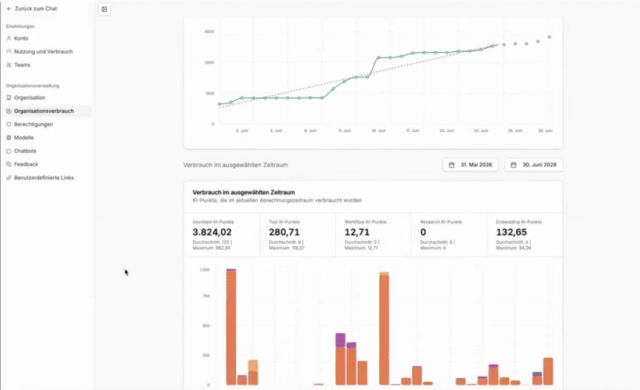
The costs of professional AI deployment are difficult to calculate: token prices fluctuate constantly, and usage varies depending on the task, frequency of use, and language model. Systematic cost monitoring thus becomes a crucial management tool for assessing which use cases are worthwhile and which employees actually need which licenses.
To this end, Kauz.ai offers a cost dashboard that transparently displays the consumption of AI points—a unit that makes the costs of different models comparable—by time period and use case. In addition, KauzSelection optimizes costs by automatically assigning each request to the appropriate LLM: Expensive top-tier models are used only where they are truly needed.
The licensing model is also designed to be flexible: Instead of rigid flat rates per user—which often force unnecessary upgrades—the pricing packages include a shared AI point allowance. If additional points are needed, they can be purchased on an ad hoc basis. This makes AI costs predictable, and companies pay only for what they actually use.
5. Think About Compliance from the Very Beginning
With the EU AI Act, the GDPR, and regulations such as DORA, the regulatory framework for AI use is becoming increasingly concrete. In particular, the traceability of AI decisions is evolving from an option to a requirement: The AI Act mandates comprehensive logging for certain AI systems to ensure traceability and human oversight.


A future-proof AI platform should not address compliance only after the fact, but should incorporate it from the ground up. That’s why our architecture is designed from the outset to meet the regulatory requirements of the EU AI Act and the GDPR—from the hosting infrastructure and data processing to the contractual framework. A finely granular role- and permission-based system ensures that only authorized individuals can review and approve AI decisions: a key component of the required human oversight.
6. Independent of external specialists
Data sovereignty has both a technical and a human dimension. Those who rely on external developers or consultants for every adjustment to their AI applications are simply trading dependence on the technology provider for dependence on the service provider. No-code platforms solve this problem by empowering business departments to independently create, maintain, and scale AI chatbots, AI agents, and AI workflows—without any IT support.
aiWorkplace and aiStudio, designed for developing AI chatbots, are consistently tailored for business users: content management, control of response behavior, and dialogue analysis are handled through a user-friendly content management system. Pre-built templates and over 500 actions in the aiWorkflow Builder also enable a quick start with multi-step AI process chains. This ensures that knowledge about the company’s own AI applications remains within the organization—and with it, control.
Data sovereignty is a matter of choice
Data sovereignty is achieved through specific architectural and selection decisions: a technology-agnostic platform with flexible model selection, open standards such as MCP, selectable operating models—including on-premises options—full transparency regarding usage, quality, and costs, integrated compliance, and the empowerment of internal business units. Companies that consistently apply these criteria when selecting a platform future-proof their AI investments—regardless of how the market and regulations evolve. The best time to set the course is now.
Try it for free or speak directly with our AI experts.
AI Impulses for AI-First Companies
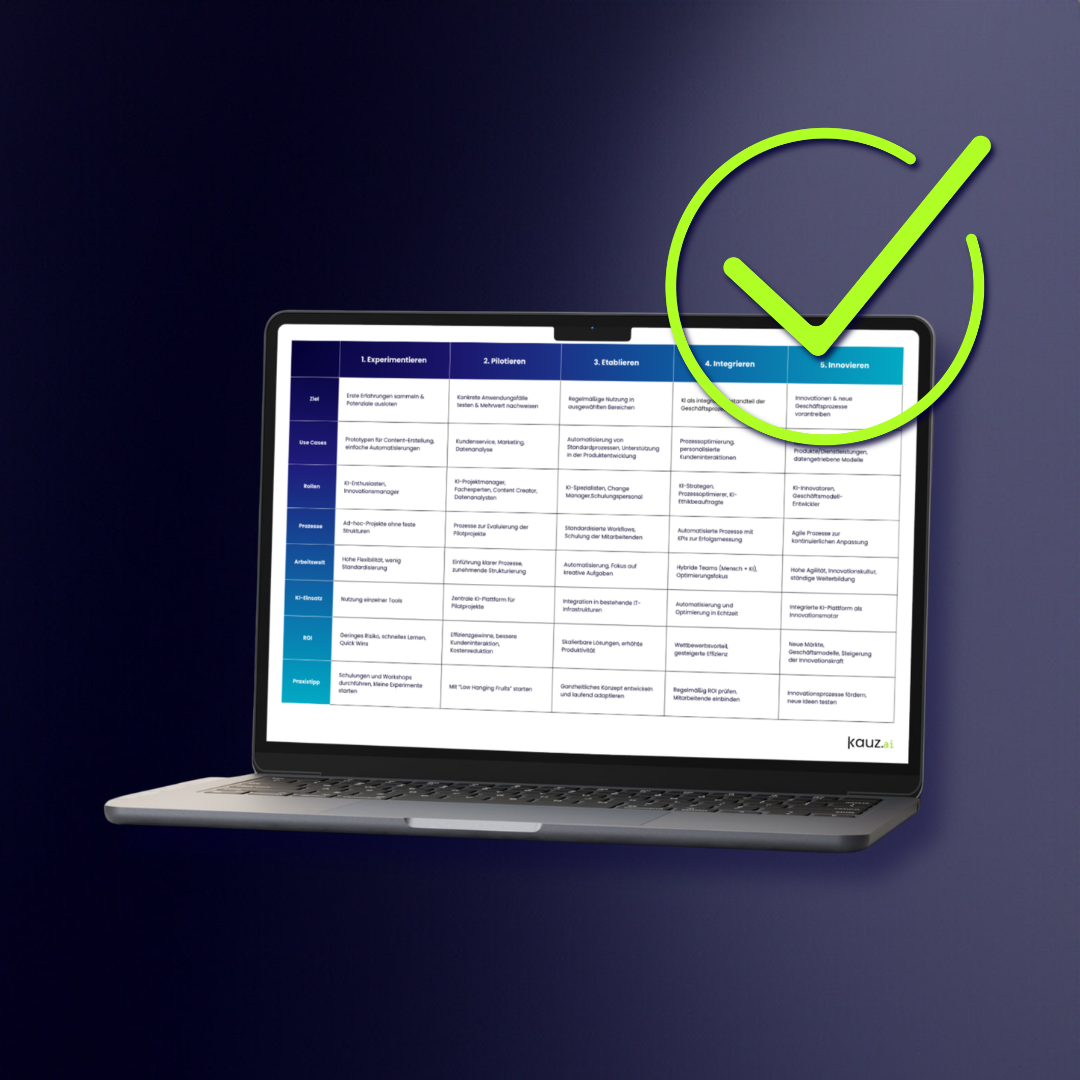
Checklist: AI Maturity Levels
Evaluate your company’s AI maturity level across eight dimensions and receive concrete recommendations for the next stages of development.
Download now
Evaluating AI Smartly: ROI Measurement
Discover in this article how to evaluate AI use cases and prioritise them using concrete performance metrics.
Learn more
AI in First-Level IT Support
Discover how our customer Bardusch uses an AI chatbot in internal IT support to simplify and automate ticket handling.
Learn more