

A guide for organizations that want to use AI to enhance their phone service and apply the right criteria in the process.
Telephone service channels have proven to be significantly more stable than many digitalization strategies had anticipated a few years ago. Particularly at municipal utilities, professional associations, chambers of commerce, universities, in the healthcare sector, and among specialized small and medium-sized businesses, the telephone remains the channel through which a significant portion of inquiries requiring clarification are received. At the same time, it is the least automated channel and the one with the highest expectations for reliability.
Das belegen aktuelle Zahlen: Laut dem Kundenservice-Barometer 2024 nutzten 78 Prozent der Befragten in Deutschland im vergangenen Jahr einen Kundenservice, und rund 92 Prozent halten dessen Qualität für ausschlaggebend für das Bild, das sie sich von einem Unternehmen machen. Das Telefon genießt dabei mit 89 Prozent — nach dem persönlichen Kontakt vor Ort — nach wie vor das höchste Vertrauen aller Kontaktkanäle.
With advances in language AI, telephone-based assistance has quickly evolved from a future prospect to an available tool. At the same time, companies are investing more heavily: According to a CX study by Verint , 66 percent stated that they intend to increase their spending on AI to boost customer satisfaction. The relevant question is therefore no longer whether the channel can be operated with AI support, but rather what criteria an organization uses to select and implement such a system. This article outlines the most important of these criteria.
The market is becoming polarized and creating a gap
The budget standard segment
At one end of the spectrum are streamlined, cost-effective solutions designed for a quick, largely self-sufficient start. They answer calls, provide business hours, answer simple questions, schedule appointments, or take messages. They are practical and efficient for clearly standardized use cases and small organizations. Their limitations become apparent when issues become more complex, require deeper knowledge, involve more sophisticated integrations, or entail heightened data protection and operational requirements.
The Enterprise Segment
At the other end of the spectrum are comprehensive contact center platforms designed for large, integrated service environments with high call volumes, sophisticatedrouting and agent processes, and dedicated automation teams. For large corporations, these are often the right choice. For many medium-sized and institutional organizations, however, they are too comprehensive, too process-heavy, and require too much integration.
The gap between them
Between these two extremes lies a large portion of the SME sector: organizations with many recurring but substantively complex phone inquiries that want to professionally design a genuine service channel — without resorting to a purely off-the-shelf solution or a large-scale contact center project. For this group, the usual decision-making frameworks are only of limited use.
Why the price per minute is the least reliable criterion
The price per minute of conversation is the most easily comparable metric on the market, which is why it dominates the discussion. That is precisely where the problem lies: comparability is not the same as informative value. The price per minute obscures the factors that determine actual service quality: the design of the conversations, the quality and verifiability of the stored knowledge, integration with specialized systems, the data protection architecture, and day-to-day operations.
In addition, the per-minute price listed is rarely the total price in practice. Depending on the offering, costs for telephony, language models, data storage, support, compliance options, and development services may be added. A sound decision is therefore not made by comparing individual per-minute rates, but by considering the overall performance over the system’s lifecycle. The relevant question, then, is not “How cheap is a minute of talk time?” but rather “How do we design a phone service that fits our organization and can be operated responsibly?”
How an AI phone assistant is technically structured
To evaluate this, it helps to take a look at the architecture underlying most systems. At its core, it consists of two levels and a tension between them.
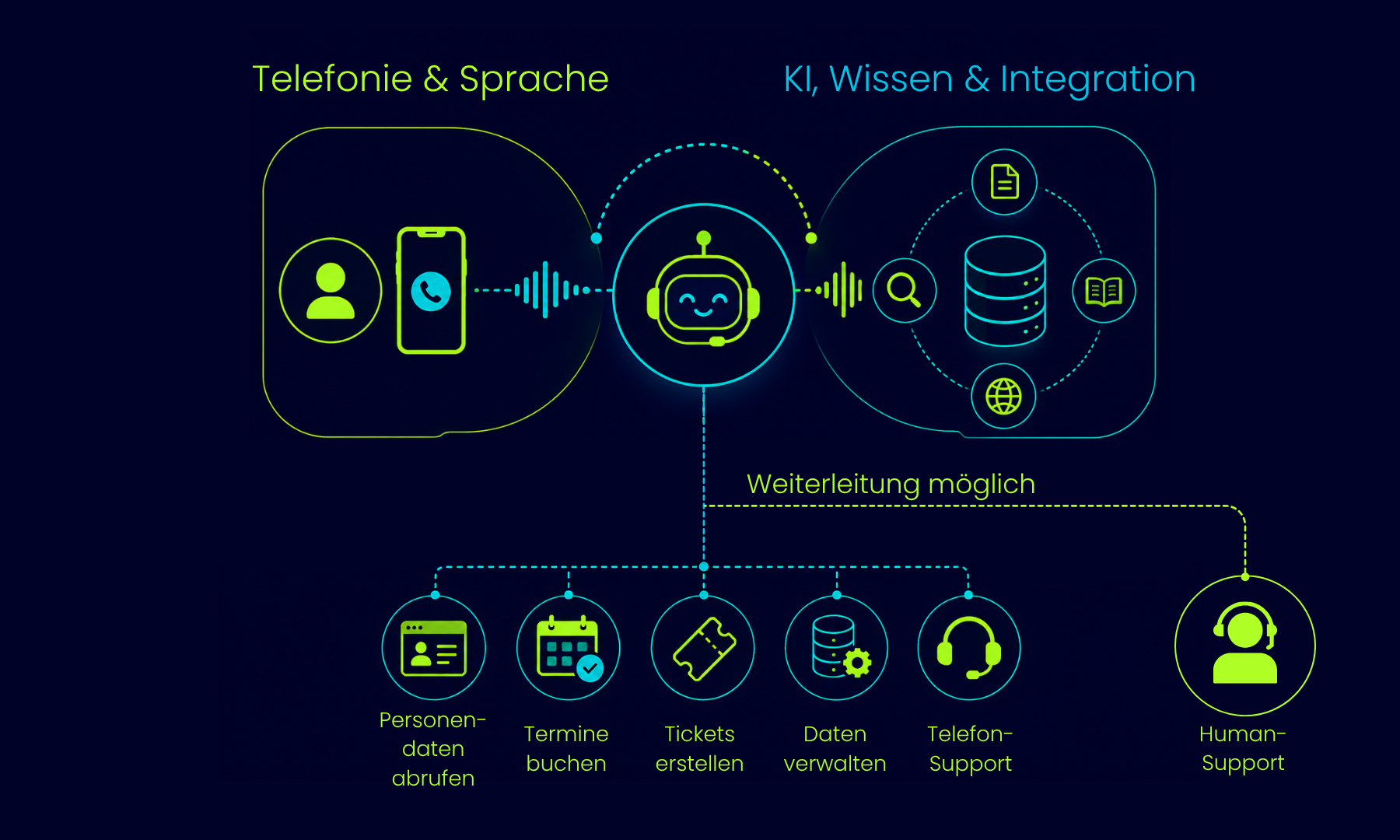
The Telephone and Voice Layer
It converts spoken language into text in real time (speech-to-text), generates speech from the responses (text-to-speech), and controls the flow of the conversation, including events and interruptions. Good voice quality and low latency — that is , the time between the end of a statement and the start of the response — are crucial for a natural listening experience.
The AI and Knowledge Level
It determines what the assistant does in terms of content: how it categorizes a request, what knowledge base it uses to respond, when it asks for clarification, and when it hands the request off to a human. This level is configured, tested, and refined over time.
The Conflict of Objectives Between Latency and Depth
These two levels are linked in a practical way that is often underestimated. A very large language model with a very broad dataset can handle more in terms of content, but tends to respond more slowly—which, unlike in chat, is immediately perceived as an uncomfortable pause on the phone. In many telephone use cases, therefore, a deliberately smaller model with a focused, well-maintained dataset is the better choice. Call quality is not achieved through maximum model size, but through the proper balance of model, knowledge, and response time.
A natural voice is a prerequisite
Synthetic voices have now advanced to the point where callers often can hardly tell they’re machine-generated. This is a significant step forward, but it’s a basic requirement—not a quality feature in and of itself. An assistant that sounds natural but miscategorizes inquiries raises expectations it cannot meet. The fact that technical naturalness alone does not build trust is also evident in the numbers: In the 2024 Customer Service Barometer, only 43 percent rate the responses from chatbots and digital assistants as trustworthy. True performance, therefore, is demonstrated through behavior: whether the assistant correctly understands the inquiry, provides reliable rather than merely plausible-sounding responses, asks meaningful follow-up questions when something is unclear, and recognizes when it’s necessary to hand the matter over to a human.
What You Need to Know for Chat and Phone Support
In many organizations, website FAQs, chatbots, and phone hotlines are managed separately — by different teams with varying levels of expertise. This creates extra work and, as callers can tell, inconsistent information across channels. The real added value of a platform-based solution therefore lies less in the fact that a system can handle phone calls, and more in the fact that phone and chat draw from the same knowledge base: knowledge is maintained once rather than multiple times, insights from one channel improve the other, and answers remain consistent. A shared knowledge base does not, however, mean identical conversation styles — phone calls follow their own rules for greetings, follow-up questions, confirmations, interruptions, and a style suited to the spoken word, and are specifically designed for the spoken medium.
Integration and Handover to People
Service calls rarely end with just providing information. It is often necessary to retrieve data, create a ticket, schedule an appointment, or continue a process in a specialized application. It is therefore crucial how flexibly a system can be integrated with existing systems such as CRM, ticketing, or specialized applications — including more specialized systems that fall outside the standard framework of common contact center integrations. Equally important is the structured handoff to staff members: A good telephone assistant recognizes their limitations and transfers the call rather than continuing a conversation that goes beyond their expertise.
Privacy by Design
Information requiring special protection is regularly discussed over the phone. For regulated service providers, public organizations, and applications in the healthcare sector, data protection is therefore not just a general selling point but a specific selection criterion — one that cannot be added after the fact. It must be clarified early on where calls and data are processed, what data flows arise, and whether the AI and knowledge infrastructure can be operated in an EU-hosted, private, or on-premises environment when requirements are more stringent. These questions belong at the beginning of a project, not in the final phase.
Die Entscheidungskriterien im Überblick
Wer eine KI-Telefonassistenz auswählt, sollte weniger auf den Minutenpreis und mehr auf das Zusammenspiel der folgenden Faktoren achten:
- Gesprächsverhalten: Wird das Anliegen zuverlässig eingeordnet, belastbar beantwortet und im Zweifel sauber übergeben?
- Modell, Wissen und Latenz: Sind Modellgröße, Datenbasis und Antwortzeit auf den Telefonkanal abgestimmt?
- Kanalübergreifendes Wissen: Schöpfen Telefon und Chat aus einer gemeinsamen, einmal gepflegten Wissensquelle?
- Qualitätssteuerung: Gibt es Transparenz über Antwortherkunft, Tests vor Änderungen und Auswertung realer Gespräche?
- Integration: Lassen sich bestehende Fachsysteme flexibel anbinden und Übergaben an Menschen geregelt umsetzen?
- Datenschutz und Betrieb: Passen Hosting- und Betriebsmodell zu den Anforderungen – von EU-Hosting bis Private Cloud oder On-Premise?
- Begleitung: Werden Konzeption, Aufbau, Test und Weiterentwicklung als eigene Leistung erbracht, nicht als Nebenkosten einer Minutenabrechnung?
A phone bot is a project, not a switch
These criteria lead to a practical conclusion: A reliable phone assistant capable of handling complex inquiries cannot be created simply by having a well-worded prompt and an active phone number. Among other things, call objectives, typical pitfalls, escalation and transfer procedures, data access, and tone of voice must be designed — and all of this must be tested before regular operation begins and continuously refined thereafter. This calls for an approach that combines the platform with ongoing support and views day-to-day operations as a distinct quality service. Availability, reducing the workload on employees, consistent service across all channels, and controlled refinement are the key metrics by which value is measured.
How to make this happen: the Phonebot from Kauz.ai
This is exactly where the Kauz.ai Phonebot comes in. It is designed for discerning small and medium-sized businesses and institutional organizations — that is, for the space between affordable standard phone assistants and enterprise call center suites, where the criteria described above take center stage.
The starting point is deliberately not an isolated telephony product, but rather the shared AI assistant platform: Phone bots are created, configured, and further developed in aiStudio and share the same knowledge base as chatbots. This allows the phone bot to answer specific queries just like the website chat, while its conversational style is specifically tailored for the voice channel. For quality control, the platform incorporates tools proven in chatbot operations — knowledge management, transparency regarding the source of responses, tests and test reports prior to changes, insight into real conversations, and, for particularly sensitive topics, expert-reviewed answers drawn from topic catalogs.
At the telephony level, Kauz.ai relies on an EU-hosted voice and telephony infrastructure; the AI and knowledge layer can be integrated with EU hosting or, for more demanding requirements, with private cloud or on-premises options . Existing systems—such as those for data retrieval, ticketing, CRM, or specialized applications—can be integrated via flexible programming interfaces, as can the handoff to employees. The platform is complemented by support for design, setup, testing, and further development—depending on the project, either as managed operations or under shared responsibility with internal teams and partners.
Phonebots for Your Customer Experience
For small and medium-sized businesses, AI-powered phone assistance is no longer a question of “if,” but of “how.” This “how” determines far more than just a single metric. Whether a phone assistant adds value depends on the interplay of several factors: the ability to control call behavior; a shared knowledge base for chat and phone interactions that allows for independent call handling; the ability to integrate into existing systems; a data protection architecture designed from the outset; and operations designed to deliver consistent quality performance.
Anyone who uses these points as a benchmark shifts their perspective: away from a tool that you activate, toward a service channel that you design. For organizations whose issues are complex and whose reputation hinges on every single call, this is the real opportunity. They can tailor the phone — often their most direct and most frequently used line of communication with customers and citizens — so that accessibility, reliability, and consistency are not left to chance. This is precisely the difference between a number answered by an AI voice and a telephone service that fits the organization.
Smart AI Solutions for Small and Medium-Sized Businesses
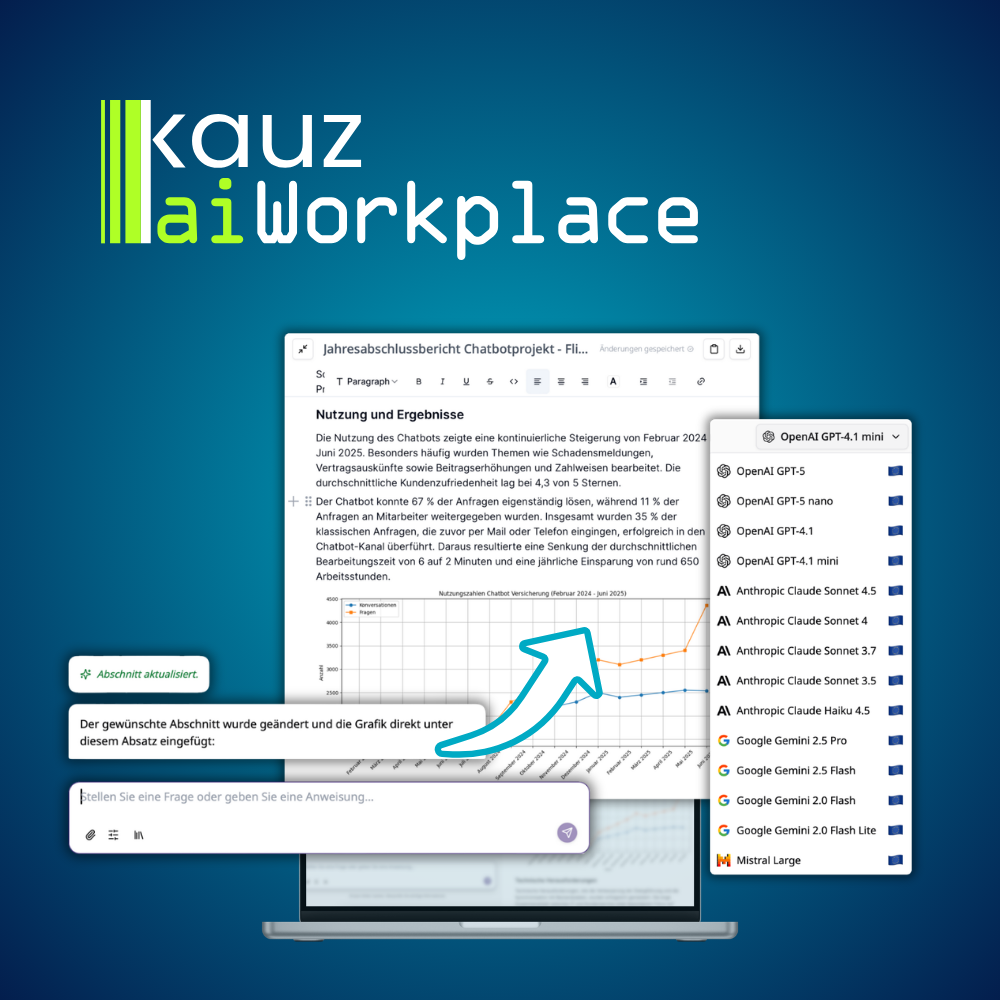
KI-Arbeitsplätze für Deine Fachteams
Biete Deinen Mitarbeiterinnen alle relevanten KI-Tools über eine zentrale Arbeitsoberfläche an und steuer aktiv den KI-Einsatz in Eurem Unternehmen.
Jetzt mehr erfahren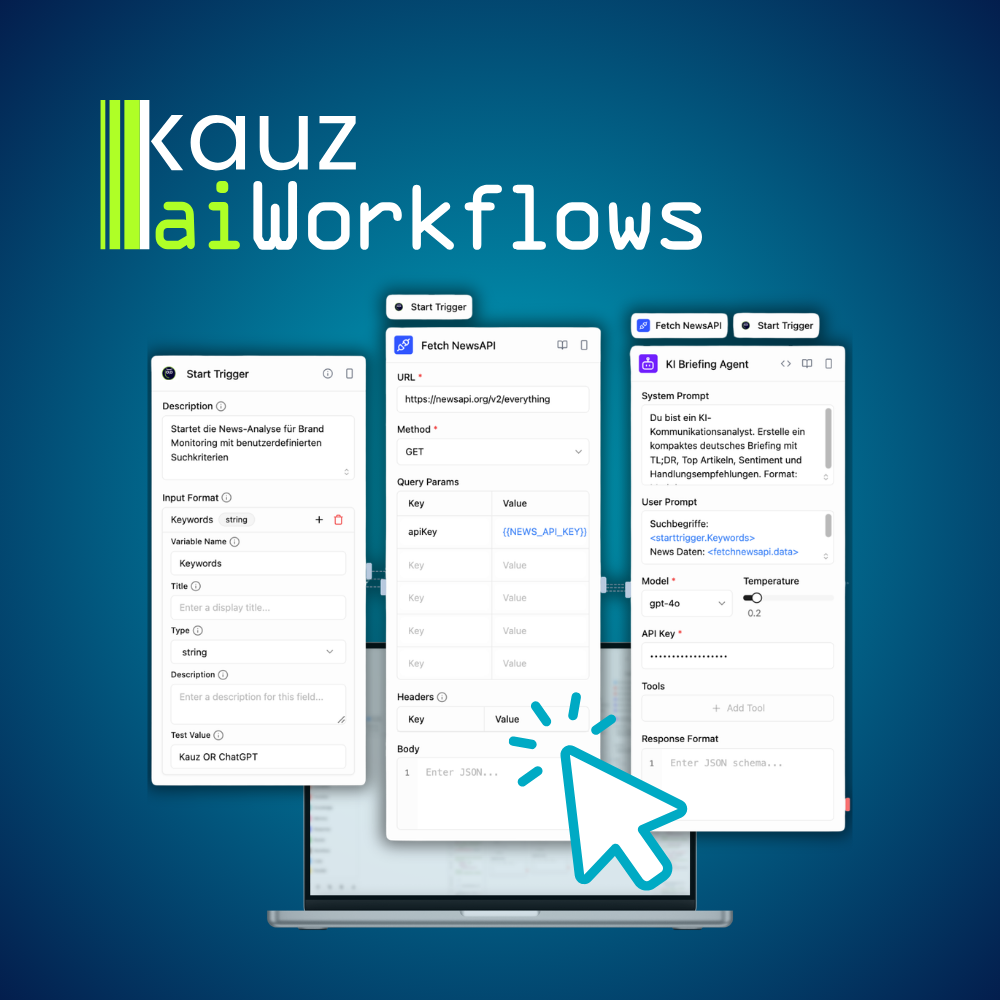
Kanalübergreifende KI-Automatisierungen
Mit über 80 Integrationen, Templates und 500 Aktionen kannst Du schnell und einfach eine Vielfalt an Arbeitsprozessen automatisieren.
Jetzt mehr erfahren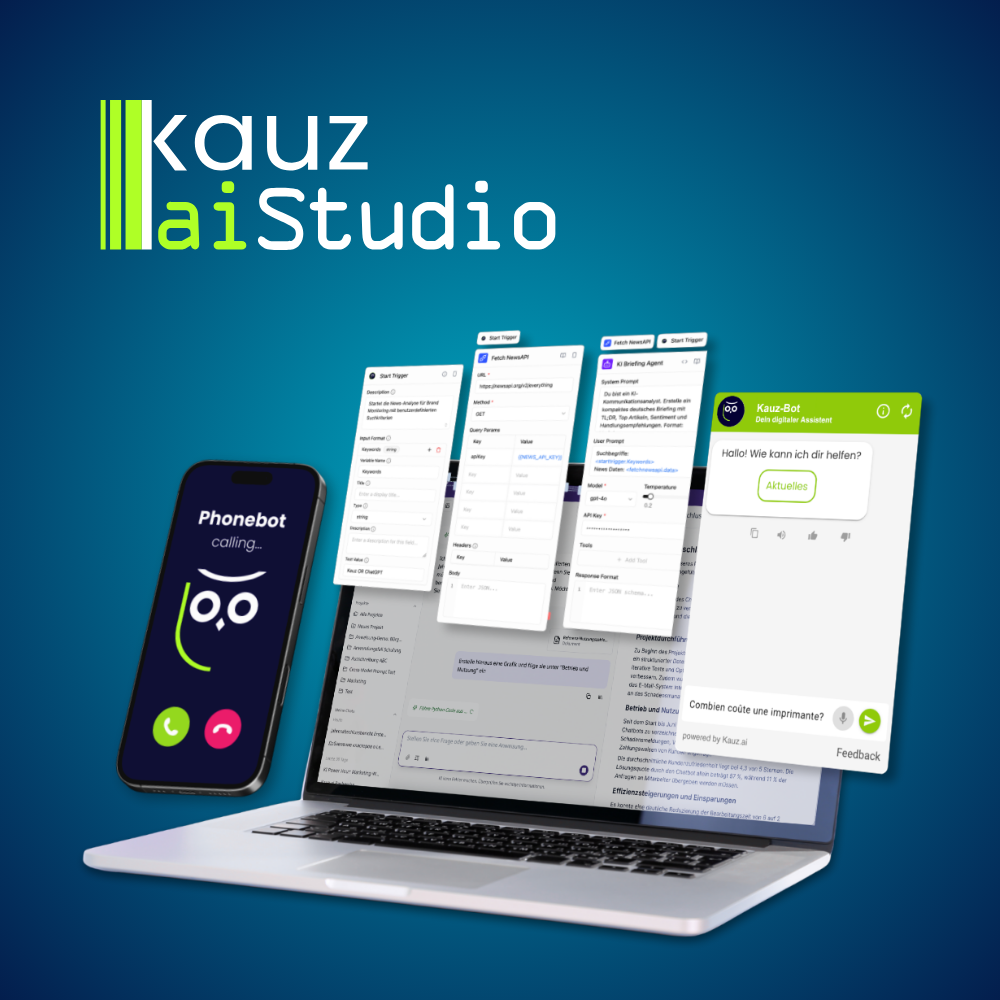
KI-Kommunikations aktiv gestalten
Ob Internet oder externer Chatbot oder Euer Phonebot - im aiStudio kannst Du das Antwortverhalten aktiv gestalten, stattfindende Dialoge einsehen und weitere Maßnahmen einleiten.
Jetzt mehr erfahren